Module 3.6: Cryptocurrency
Cryptocurrency
It’s not investing. It’s not a scam. Understanding exactly what it is changes everything about how you should approach it.
By the end of this lesson, you’ll be able to:
- Explain what cryptocurrency is and how it actually works at a basic level.
- Describe the core difference between investing and speculating — and place crypto correctly.
- Identify the real risks: volatility, exchange failures, scams, and the “greater fool” dynamic.
- Explain what happened with FTX and Luna as real-world cautionary examples.
- Apply a framework to decide whether, when, and how much crypto belongs in your financial life.
1. What Cryptocurrency Actually Is
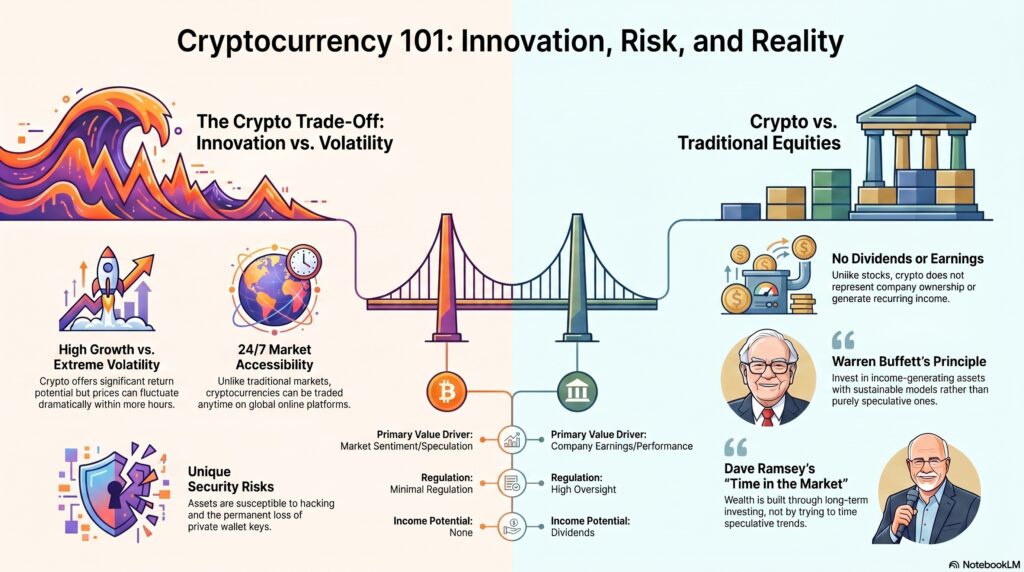
Cryptocurrency is a digital currency that exists on a decentralized network called a blockchain — a shared ledger of transactions that no single government or bank controls. You don’t hold a bill or a coin; you hold a cryptographic key that proves ownership of a digital entry on that ledger.
Bitcoin was the first, created in 2009 as an alternative to government-issued money. Ethereum followed, enabling programmable contracts on its blockchain. Since then, thousands of cryptocurrencies have launched — ranging from serious projects with real utility to outright jokes that somehow accumulated billions in market cap before collapsing.
Bitcoin (BTC)
The original. Fixed supply of 21 million coins. Primarily used as a store of value — digital gold. Most established and widely held.
Ethereum (ETH)
A programmable blockchain. Powers smart contracts, NFTs, and decentralized apps (DeFi). Has genuine technological utility beyond just a currency.
Altcoins & Meme Coins
Thousands of others — from legitimate projects to outright jokes. Dogecoin started as a meme. Some have surged 10,000%. Most go to near zero.
2. The Critical Question: Investing or Speculating?
In Lesson 3.5, we drew the line between investing and trading. Now we need one more distinction: investing vs. speculating. It explains almost everything about why crypto feels different from buying an index fund.
The “Greater Fool” Theory
When an asset’s price is driven purely by the expectation that someone else will pay more for it later, economists call this the Greater Fool Theory. You might profit — but only if there’s a “greater fool” willing to buy from you at a higher price. The person left holding when sentiment shifts takes the loss.
This doesn’t mean crypto can’t go up. It can — and has, dramatically. It means the mechanism driving the price is fundamentally different from a stock whose price rises because the underlying company is generating more revenue. Understanding which game you’re playing matters enormously for how much you stake and what you expect.
3. The Real Risks — Beyond Just Volatility
Most crypto content focuses on upside. Here’s an honest accounting of the risks that cost real people real money:
Extreme Volatility
Bitcoin lost over 70% of its value in 2018. Then 65% in 2022. These aren’t edge cases — this is the normal volatility range. Most altcoins swing even harder. A 50% drop overnight is not unusual in smaller coins.
Exchange Risk
If you hold crypto on an exchange and it collapses, your coins may be gone. Unlike bank deposits, crypto on an exchange is not FDIC insured. You’re an unsecured creditor. See: FTX (below).
Lost Keys = Lost Crypto
If you hold your own crypto in a wallet and lose the private key or seed phrase, it’s gone forever. Estimates suggest 20% of all Bitcoin is permanently inaccessible due to lost credentials. No customer service to call.
Scams & Rug Pulls
New coins launch daily. A “rug pull” is when developers hype a coin, collect investor money, then drain the liquidity pool and disappear overnight. It’s the crypto version of a Ponzi scheme — and it happens constantly.
Regulatory Uncertainty
Governments worldwide are still figuring out how to treat crypto. A single regulatory announcement has moved entire markets 20%+ in a day. Rules can change. Tax treatment is complex and evolving.
Influencer Hype Cycles
Celebrities and influencers have been paid to promote tokens that later collapsed, costing their audiences millions. By the time the promotion reaches you, the promoter may already be selling their position.
4. When It Goes Wrong: FTX and Luna
These aren’t distant warnings. Both collapsed within the last few years and wiped out billions in real savings from real people — many of them young.
Terra Luna (May 2022)
Luna was a top-10 cryptocurrency by market cap. Its paired “stablecoin” UST was supposed to always be worth $1. In a single week in May 2022, the entire system collapsed. Luna went from ~$80 to fractions of a cent. UST lost its $1 peg entirely.
Estimated losses: $60 billion in market value, evaporated in days. Many retail holders lost their life savings. The asset that was “safe” turned out to be built on a circular mechanism that unraveled under pressure.
FTX Exchange (November 2022)
FTX was one of the largest crypto exchanges in the world — sponsored sports arenas, ran Super Bowl ads, and had celebrity endorsers. In November 2022, it was revealed that the company had been misusing customer funds. It filed for bankruptcy within days.
Estimated customer losses: $8+ billion. Founder Sam Bankman-Fried was later convicted of fraud. Customers who held their crypto on FTX had no FDIC protection and lost access to their funds.
In traditional finance, banks are regulated, insured, and audited. In crypto, you are largely on your own. “Not your keys, not your coins” is the community saying — meaning if you don’t hold your own wallet, you’re trusting a third party with zero government backstop. That’s a risk traditional investors never have to take.
5. So Should You Have Any Crypto? A Framework.
This lesson isn’t saying crypto is worthless or that everyone who holds it is naive. Bitcoin has been the best-performing asset over the last decade in terms of raw returns. Blockchain technology has genuine real-world applications. The question isn’t “is crypto real?” — it’s “how does it fit into a sound financial plan?”
Check Your Understanding
Pick your answer, then tap “Reveal answer” to check yourself.
1. Why is buying Bitcoin more accurately described as speculating than investing?
A) Bitcoin is illegal in most countries | B) Bitcoin produces no earnings, dividends, or underlying business value — its price is driven by what the next buyer will pay | C) Bitcoin has never increased in value | D) Speculating and investing mean the same thing
Reveal answer & explanation
Correct: B. A stock is anchored to a company’s earnings and real output. Bitcoin has no earnings, no dividends, no underlying business. Its price moves based on sentiment and expectations of demand — that’s the definition of speculation. A is false. C is wildly false — Bitcoin has had enormous gains. D ignores the important distinction this lesson and 3.5 established.
2. What is a “rug pull” in crypto?
A) When regulators ban a cryptocurrency | B) When a coin’s price drops due to market conditions | C) When developers hype a token, collect investor money, then drain the funds and disappear | D) When an exchange freezes withdrawals temporarily
Reveal answer & explanation
Correct: C. A rug pull is deliberate fraud — developers build hype around a project, attract investment, then drain the liquidity and disappear with the funds, leaving holders with worthless tokens. It’s distinct from a natural price drop (B) or regulatory action (A). D is a different issue called a withdrawal freeze, which FTX also did before its collapse.
3. What was the key lesson from the FTX collapse for everyday crypto holders?
A) Crypto exchanges are just as safe as banks | B) Only Bitcoin is safe | C) Crypto held on an exchange has no FDIC insurance — if the exchange fails, your funds may be gone | D) FTX was a rare exception that can’t happen again
Reveal answer & explanation
Correct: C. FTX customers lost access to billions because they trusted an exchange with no regulatory backstop. Unlike a bank deposit insured by the FDIC, crypto on an exchange is unsecured. A is precisely the dangerous assumption FTX shattered. B overstates Bitcoin’s insulation from exchange risk — BTC held on FTX was also frozen. D ignores the fact that exchange failures have occurred multiple times in crypto history.
4. According to the framework in this lesson, what should come before any crypto purchase?
A) Researching the best altcoins | B) Setting up a crypto wallet | C) Building an emergency fund, HYSA savings, and starting index fund contributions | D) Waiting for the next bull market
Reveal answer & explanation
Correct: C. The foundation comes first: emergency fund, stable savings, and consistent index fund investing. Speculating with money you may need is how financial plans get derailed. A and B skip the foundation entirely. D is market timing — which doesn’t work reliably even for stocks, let alone crypto.
5. A friend tells you to put half your savings into a new coin because “it’s the next Bitcoin.” What’s the most financially sound response?
A) Do it — early adopters always win | B) Research it quickly and follow their advice if it looks legit | C) Decline — putting half your savings into any speculative asset violates basic risk management regardless of the story | D) Buy a small amount to show support
Reveal answer & explanation
Correct: C. Concentration risk — putting a large portion of savings into any single speculative asset — is a violation of basic financial principles regardless of how compelling the story is. “Next Bitcoin” has been said about thousands of coins that went to zero. Even if you believe in the asset, 50% of savings is wildly outside any reasonable allocation. A assumes early adoption always pays off — it doesn’t. B sounds careful but doesn’t address the position-size problem. D conflates social dynamics with financial decisions.
Key Takeaways
- Cryptocurrency is a digital asset on a decentralized blockchain — not a government currency and not a company you own.
- Holding crypto is speculating, not investing — its price is driven by sentiment and demand, not earnings or dividends.
- The Greater Fool Theory: you profit only if someone pays you more than you paid. When sentiment shifts, the last holder absorbs the loss.
- Real risks: extreme volatility, exchange failures (FTX), algorithmic collapse (Luna), rug pulls, lost keys, and influencer-driven pump-and-dump cycles.
- Crypto on an exchange is not FDIC insured. If the exchange collapses, you are an unsecured creditor.
- If you choose to participate: build your financial foundation first, cap exposure at 5% or less, stick to established coins, and call it what it is — a speculative bet, not a retirement strategy.
That wraps Module 3 — the full picture of saving, investing, compounding, fees, and the crucial distinctions that separate wealth-building from speculation. In Module 4 we zoom out to the big picture: assets vs. liabilities, and how understanding the difference is the foundation of everything that follows.
© Coy Academy • Financial Literacy: What School Should’ve Taught About Money