Lesson 1.1: Why Financial Literacy Matters
Why Financial Literacy Matters
The one subject school skipped — and the one that quietly shapes the rest of your life.
By the end of this lesson, you’ll be able to:
- Define financial literacy in plain language.
- Explain why money skills matter more for your generation than for any before it.
- Identify the four big things financial literacy lets you do.
- Recognize common money traps — and the real cost of waiting to learn.
1. What Is Financial Literacy?
Financial literacy is the knowledge and skill to manage your money well — earning it, budgeting it, saving it, borrowing it carefully, and growing it over time. It’s not about being rich or having a finance degree. It’s about understanding how money actually works so you can make choices that serve you instead of stumbling into ones that quietly drain you.
Think of it as the operating manual for adult life. Nobody hands you one — but the people who figure it out early get a massive head start.
2. Why It Matters More Than Ever Right Now
Every generation needs money skills. But the financial world you’re stepping into is faster, slipperier, and more designed to separate you from your money than the one your parents faced. Here’s what’s different:
One tap pays. “Buy Now, Pay Later” apps like Klarna and Afterpay split a $60 purchase into four payments and make debt feel like a non-event. It isn’t — it’s still debt, just disguised.
Finfluencers on TikTok and YouTube push coins, courses, and “get rich” plays — often because they’re paid to. Hype is not research, and most of it is selling you something.
Side hustles, gig work, and 1099 pay mean no automatic taxes withheld and no built-in retirement plan. More freedom — and more responsibility on you.
Rent, tuition, and groceries have outpaced wages for years. Subscriptions quietly stack up. Knowing where your money goes is no longer optional.
None of this means you’re doomed. It means the people who learn the rules of the game early get to play it on easy mode — while everyone else pays “the broke tax” in late fees, interest, and missed opportunities.
3. What Financial Literacy Lets You Do
Once you understand how money works, four powerful things open up:
Make Informed Decisions
Knowing the difference between a debit card, a credit card, and BNPL helps you spend on your terms and avoid debt you didn’t mean to take on.
Plan for the Future
Budgeting and saving turn “someday” goals — a car, a move, college, retirement — into things you actually reach instead of hope for.
Avoid Money Traps
Understanding interest rates and fees keeps you out of payday loans, minimum-payment credit card spirals, and “0% intro” deals that aren’t.
Build Wealth
Knowing how saving and investing — like low-fee index funds — grow money over time lets you put your dollars to work instead of letting them sit.
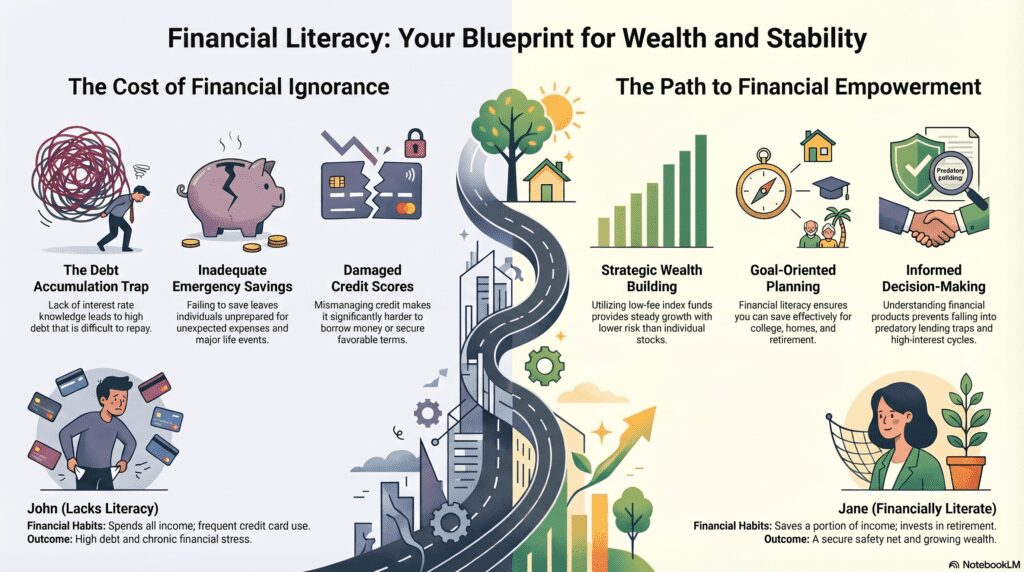
4. The Real-World Impact: Two Paths
Meet two people who earn almost the same income but make very different choices.
Devin spends everything
He pays for things with credit and BNPL, carries a balance, and pays interest every month. There’s nothing left to save, so any surprise — a car repair, a medical bill — becomes more debt. The stress compounds along with the interest.
Maya pays herself first
She saves a slice of every paycheck and invests a little in a retirement account. She builds an emergency cushion, so surprises are an inconvenience, not a crisis. Over time her money quietly grows in the background.
The cost of waiting (this is the part nobody shows you)
Imagine investing just $150 a month at a hypothetical 7% average annual return until age 65:
Waiting ten years — putting in only about $18,000 less — cost roughly $300,000. That gap isn’t from earning more. It’s from time. This is the power of compound interest, and it’s exactly why starting now beats starting “later.” (Illustration only; returns vary and aren’t guaranteed.)
5. What’s at Stake
Skipping these skills has real consequences — and building them pays off in equally real ways.
Without it
- Debt piles up as interest and fees snowball.
- No savings means emergencies turn into crises.
- A damaged credit score makes future loans harder and pricier.
With it
- You spend with intention and stay out of bad debt.
- A cushion gives you options — and peace of mind.
- Strong credit and growing investments open doors.
Check Your Understanding
Pick your answer, then tap each question to reveal the explanation.
1. What does “financial literacy” mean?
A) Being wealthy | B) The knowledge and skills to manage money well | C) Having a finance degree | D) Knowing stock ticker symbols
Correct: B. Financial literacy is about understanding and applying money skills — budgeting, saving, borrowing, investing. A confuses literacy with the result it can help produce. C isn’t required; anyone can build these skills. D is one narrow sliver, not the whole picture.
2. A friend says, “I’ll start investing once I make more money.” Why is starting now usually smarter?
A) Small early contributions grow more, thanks to compound interest | B) Investing is only for people with extra cash | C) You should wait until markets are perfect | D) Time has no effect on growth
Correct: A. The earlier you start, the longer compounding works — as the example showed, ten years of delay can cost hundreds of thousands. B is the trap that keeps people from ever starting. C is “timing the market,” which even pros rarely get right. D is the exact opposite of how compounding works.
3. What’s the financial-literacy red flag with “Buy Now, Pay Later” apps?
A) They’re always free | B) They can mask overspending and stack up into real debt with late fees | C) They build your credit automatically | D) They’re the same as paying cash
Correct: B. Splitting a purchase into four payments makes it feel painless, but it’s still debt — and multiple BNPL plans plus late fees add up fast. A is false once you miss a payment. C usually isn’t true and may even hurt your credit. D ignores that you owe money you don’t yet have.
4. Which is a money trap that financial literacy helps you avoid?
A) Paying only the minimum on a high-interest credit card | B) Building an emergency fund | C) Comparing loan interest rates | D) Saving part of each paycheck
Correct: A. Paying just the minimum keeps you in debt for years while interest piles up — a classic trap. B, C, and D are all smart habits financial literacy encourages, not traps.
5. Why isn’t a TikTok finfluencer hyping a coin a reliable reason to invest?
A) Social media is never useful | B) They’re often paid to promote it and have a conflict of interest | C) Coins are illegal | D) You should always do the opposite of what they say
Correct: B. Many influencers are compensated to hype products, so their advice may serve them, not you — and hype is not research. A overstates it; social media can be useful if you verify. C is false. D is just as thoughtless as blindly following — the goal is to research, not react.
Key Takeaways
- Financial literacy is the practical skill of managing money — not wealth or a degree.
- Today’s frictionless spending, hype culture, and gig income make these skills more urgent than ever.
- It lets you decide wisely, plan ahead, dodge traps, and build wealth.
- Time is your biggest advantage — starting now beats starting “later,” every time.
Ready to put this into action? In Lesson 1.2, we’ll turn these ideas into real, reachable goals — and start building your personal financial plan.
© Coy Academy • Financial Literacy: What School Should’ve Taught About Money