Lesson 2.3: Creating a Personal Budget
Creating a Personal Budget
A budget isn’t a restriction — it’s permission to spend. On your terms.
By the end of this lesson, you’ll be able to:
- Define what a personal budget is and what it actually does for you.
- Build a simple first budget using your tracked expenses from 2.2.
- Apply the “pay yourself first” principle from day one.
- Understand what to do when your budget doesn’t balance.
1. What a Budget Actually Is
A lot of people hear the word “budget” and picture restriction — a list of things they can’t do. That’s backward. A budget is a plan. It’s you deciding in advance where your money goes instead of wondering afterward where it went.
At its core, a budget is one simple equation:
If the number is positive → you have room to save or invest more.
If it’s negative → something has to change. That’s useful information, not a verdict.
A budget gives your money a job. Every dollar either goes toward a need, a want, or a goal — nothing floats around unaccounted for.
2. Pay Yourself First
Before we get into the steps, there’s one principle that changes everything: pay yourself first.
Most people pay their bills, spend on whatever they want, and save what’s left. The problem? There’s usually nothing left. Paying yourself first flips that order: savings come out first, the moment money hits your account — before rent, before groceries, before anything. You live on what remains.
The usual order (broken)
Income arrives → pay bills → spend freely → save whatever’s left
Result: usually $0 saved.
Pay yourself first (works)
Income arrives → savings out immediately → pay bills → spend what remains
Result: savings happen every time.
Even $25 or $50 a paycheck adds up. The habit matters more than the amount when you’re starting out.
3. Building Your First Budget in 5 Steps
You already did the hard part in Lesson 2.2 — you tracked your expenses and saw where your money went. Now you’re going to use that data to build a plan for next month.
Use your actual after-tax income — what lands in your account, not what’s on your offer letter. Include all sources: job, side hustle, anything regular. If your income varies, use a conservative average.
Before you budget a single expense, decide how much you’re saving. Even a small fixed amount works. Automate the transfer so it moves on payday without a second thought.
Write down every non-negotiable monthly cost: rent, phone bill, insurance, loan payments, and subscriptions you’re keeping. Add them up.
Look at what you actually spent last month from your 2.2 tracking. Keep what’s reasonable, trim what surprised you. Assign a ceiling to each variable category.
Add savings + fixed + variable. Subtract from income. Positive? Great — decide what to do with the extra. Negative? Something has to flex. Usually that’s variable spending, not savings.
4. Maya’s First Budget
Here’s how those five steps look all together in one view:
| Category | Budgeted | Type |
|---|---|---|
| Savings (pay yourself first) | $350 | Priority |
| Rent | $750 | Fixed |
| Phone | $65 | Fixed |
| Car insurance | $90 | Fixed |
| Subscriptions (trimmed) | $45 | Fixed |
| Groceries | $200 | Variable |
| Gas | $80 | Variable |
| Takeout | $100 | Variable |
| Entertainment | $60 | Variable |
| Personal care | $40 | Variable |
| Total budgeted | $1,780 | $220 buffer remaining |
That $220 buffer is her safety net for unexpected costs. If nothing comes up, it rolls into savings next month.
5. When the Math Doesn’t Work
Your first draft might come up short. That’s normal — and it’s exactly why you make a budget before spending instead of after. When expenses outrun income, you have two levers:
Lever 1: Cut variable spending
This is your most flexible option. Trim takeout, drop unused subscriptions, pull back on entertainment. Start here before touching anything else.
Lever 2: Bring in more income
A side hustle, extra shifts, or selling things you don’t need can bridge a gap. Remember those Cashflow Quadrant lessons from 2.1.
Savings is the last thing you cut, not the first. If the budget is tight, reduce your savings amount temporarily — even $10 a month keeps the habit alive. Don’t cut it to zero.
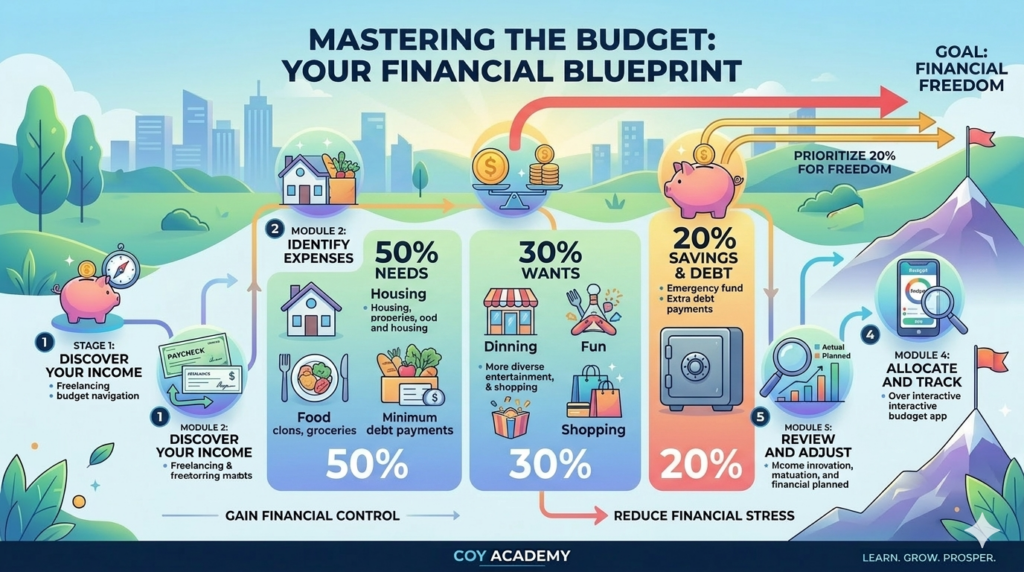
There are several proven budgeting frameworks that go deeper than what we’ve covered here — including popular percentage-based methods and zero-based budgeting. Module 5 breaks them all down so you can pick the one that actually fits your life.
Check Your Understanding
Pick your answer, then tap “Reveal answer” to check yourself.
1. What does a personal budget actually do?
A) Prevents you from spending on things you enjoy | B) Gives every dollar a job so you decide where money goes instead of wondering afterward | C) Only matters if you earn a lot | D) Replaces the need to track expenses
Reveal answer & explanation
Correct: B. A budget is a spending plan, not a spending ban. It puts you in control. A misunderstands the purpose — a good budget includes spending on wants. C is false; budgets matter most at lower incomes. D is backwards — tracking feeds the budget, not the other way around.
2. “Pay yourself first” means:
A) Buying what you want before paying bills | B) Moving savings out as soon as income arrives, before spending anything | C) Saving whatever is left at month’s end | D) Prioritizing your highest bills first
Reveal answer & explanation
Correct: B. Savings come out first — before rent, before groceries, before anything else. C is the common approach that usually leaves nothing to save. A is impulse spending, not a strategy. D describes a bill-priority system, not paying yourself.
3. What is the correct first step when building your budget?
A) List your wants | B) Set your savings amount | C) Calculate your actual take-home income | D) Download a budgeting app
Reveal answer & explanation
Correct: C. You can’t plan spending without knowing what you’re working with. Take-home income is the foundation everything else is built on. B is step 2. A comes later. D is a tool choice, not a budgeting step.
4. Maya’s income is $2,000. After savings ($350), fixed expenses ($950), and variable expenses ($480), how much is her buffer?
A) $420 | B) $150 | C) $220 | D) $300
Reveal answer & explanation
Correct: C. $2,000 − $350 − $950 − $480 = $220. That’s her buffer for unexpected costs. A ($420) is the buffer before she boosted savings by an extra $200. B and D don’t match the math.
5. Your budget comes up short. Which should you cut first?
A) Savings | B) Rent | C) Variable expenses like takeout and entertainment | D) All expenses equally
Reveal answer & explanation
Correct: C. Variable expenses are the most flexible lever. Start there. A should be the last resort — even a small savings amount keeps the habit alive. B is a fixed expense you usually can’t change quickly. D ignores that not all expenses are equally cuttable.
Key Takeaways
- A budget is a spending plan, not a punishment — it gives your money a purpose.
- Always pay yourself first: savings out before anything else gets spent.
- Build your budget in five steps: income → savings → fixed → variable → check the math.
- When it doesn’t balance, cut variable spending before touching savings.
- Module 5 goes deeper with proven budgeting frameworks — this is your foundation.
You’ve now got income understood, expenses tracked, and a budget drafted. In Module 3, we take that savings habit you just built and put it to work — starting with why saving is more powerful than most people realize.
© Coy Academy • Financial Literacy: What School Should’ve Taught About Money