Lesson 1.2: Setting Financial Goals
Setting Financial Goals
Turn vague “I should save more” energy into a clear plan, your future self will thank you for.
By the end of this lesson, you’ll be able to:
- Explain why financial goals make money easier to manage.
- Tell short-, medium-, and long-term goals apart.
- Build a SMART goal you can actually measure.
- Use simple systems to hit your goals without relying on willpower.
1. Why Bother Setting Goals?
Money without a goal tends to just… disappear. A few taps here, a subscription there, and the paycheck’s gone with nothing to show for it. That’s vibes-based spending. A goal flips the script — it turns your money into a tool that’s working toward something you picked.
Here’s what a clear goal does for you:
You know what you’re spending for, so it’s easier to say no to the stuff that doesn’t matter.
Watching a number climb toward a target is weirdly satisfying — and it keeps you going.
A goal gives the boring habit a point. You’re not just “saving” — you’re funding something real.
When choices align with a goal, “Should I buy this?” becomes much easier to answer.
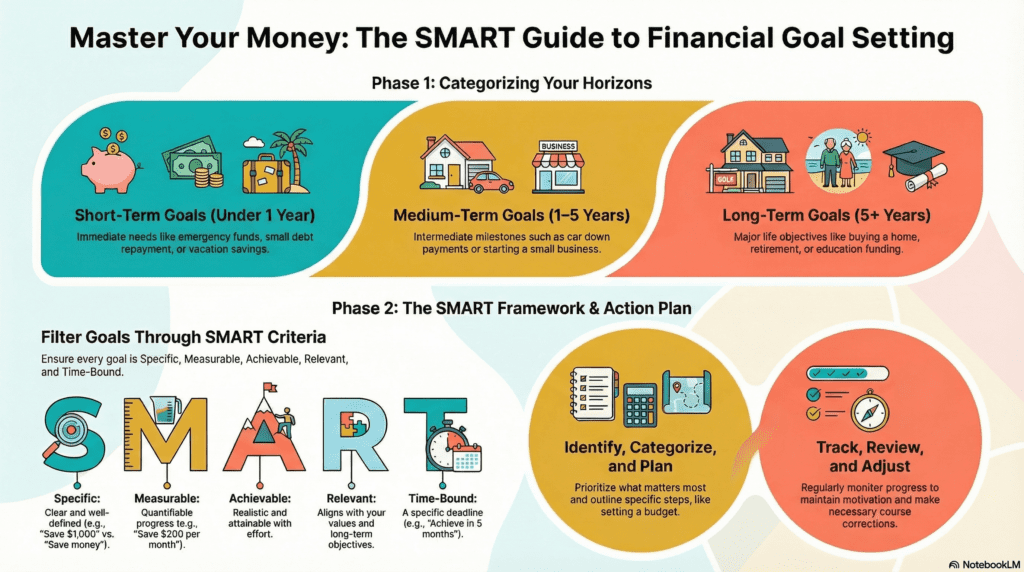
2. The Three Types of Goals
Not every goal works on the same timeline. Sorting them by when helps you plan realistically.
Short-Term (within ~1 year)
Build a starter emergency fund, pay off a Klarna balance, save for concert tickets or a new phone.
Medium-Term (1–5 years)
Save for a car down payment, move into your own place, pay off student loans, or fund a big trip.
Long-Term (5+ years)
Buy a house, build serious investments, or start funding retirement (yes, starting now is the cheat code).
3. Make It SMART
“I want to save money” isn’t a goal — it’s a wish. The SMART framework turns a wish into something you can actually do. Run every goal through these five filters:
| Specific | Say exactly what you want. Not “save money” but “save $1,000 for an emergency fund.” |
| Measurable | Attach a number you can track, like “$200 a month toward my $1,000 target.” |
| Achievable | Keep it real. The amount and timeline should fit your actual income. |
| Relevant | It should matter to you and line up with your bigger plans. |
| Time-Bound | Set a deadline. “Within 5 months” creates just enough pressure to act. |
4. SMART Goals in Action
See how each goal names the amount, the timeline, and the monthly move:
“I’ll save $500 for a new laptop by setting aside $50 from each of my next 10 paychecks.”
“I’ll pay off my $3,000 credit card by paying $250 a month for the next 12 months.”
“I’ll save $20,000 for a house down payment in 5 years by putting $333 a month into a dedicated account.”
5. How to Actually Hit Them
A goal on paper is easy. Hitting it is where people slip. So build systems that don’t depend on you “feeling motivated”:
- Pay yourself first. The second money hits your account, move some to savings — before you can spend it.
- Automate it. Set up an automatic transfer on payday. Now saving happens whether you remember or not.
- Use separate “buckets.” Many banking apps let you create labeled savings goals (a trip, a car, an emergency fund). Seeing them fill up keeps it real.
- Check in monthly. A quick five-minute review keeps you on track and lets you adjust when life changes.
Check Your Understanding
Read each question and pick your answer, then tap “Reveal answer” to check yourself.
1. Which of these is a true SMART goal?
A) “I want to save more money.”
B) “I’ll save $600 for a used laptop by setting aside $100 a month for 6 months.”
C) “I should probably start investing someday.”
D) “I want to be rich.”
Reveal answer & explanation
Correct: B. It’s specific, measurable ($600), achievable, relevant, and time-bound (6 months). A and D have no number or deadline. C names no amount and “someday” isn’t a deadline.
2. A short-term goal is one you aim to reach within about:
A) one year | B) 1–5 years | C) 5–10 years | D) 20+ years
Reveal answer & explanation
Correct: A. Short-term goals land within roughly a year. B describes medium-term goals, and C and D fall into long-term territory.
3. Your friend wants $1,200 for a trip in 12 months but only sets aside $20 a month. Which SMART criterion breaks down?
A) Specific | B) Measurable | C) Achievable / Time-Bound | D) Relevant
Reveal answer & explanation
Correct: C. At $20 a month, 12 months only reaches $240 — nowhere near $1,200. The plan isn’t achievable in that timeframe; they’d need about $100 a month. The goal is specific, measurable, and relevant — the math is just off.
4. What’s the most reliable way to hit a savings goal without depending on willpower?
A) Save whatever’s left at the end of the month
B) Automate a transfer to savings on payday (“pay yourself first”)
C) Keep it in checking and try not to spend it
D) Save only when you feel motivated
Reveal answer & explanation
Correct: B. Automating it on payday means saving happens before you can spend the money. A usually leaves nothing left over. C keeps the cash too easy to touch. D relies on motivation, which always fades.
5. Which of these is a long-term financial goal?
A) Building a $1,000 emergency fund this year
B) Saving for a car down payment in 2 years
C) Saving for retirement
D) Paying off a $300 BNPL balance next month
Reveal answer & explanation
Correct: C. Retirement is years — usually decades — away, so it’s long-term. A and D are short-term (within a year), and B is medium-term (1–5 years).
Key Takeaways
- Goals turn aimless spending into money that works toward what you want.
- Sort goals by timeline: short-term (~1 yr), medium-term (1–5 yrs), long-term (5+ yrs).
- SMART goals are Specific, Measurable, Achievable, Relevant, and Time-Bound.
- Automate and “pay yourself first” so progress doesn’t depend on willpower.
Now that you can set a goal, let’s make sure you can speak the language. In Lesson 1.3, we’ll break down the basic financial terms you’ll see everywhere from here on out.
© Coy Academy • Financial Literacy: What School Should’ve Taught About Money