Lesson 2.1: Sources of Income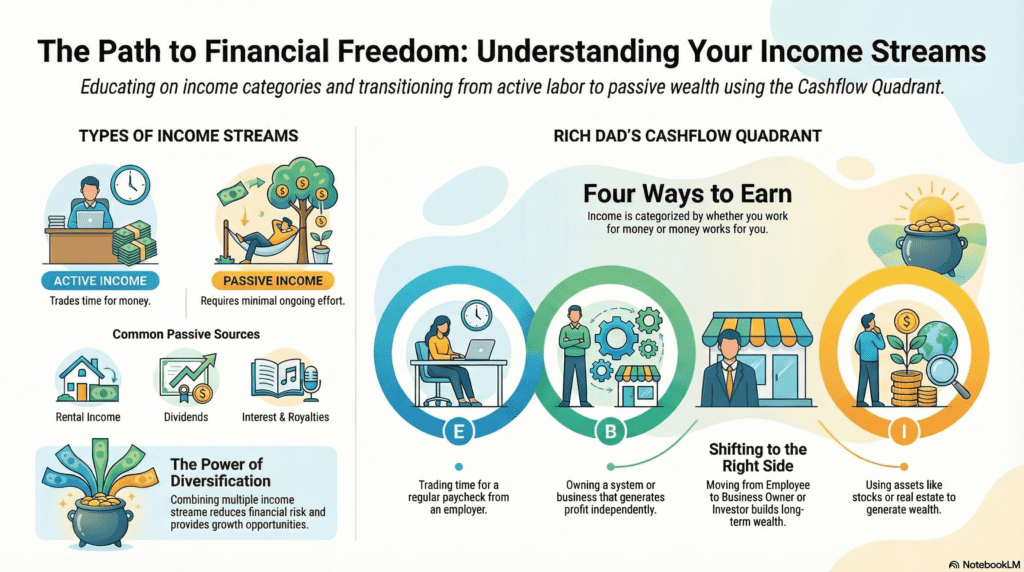
Sources of Income
Where money actually comes from — and why how you earn it matters as much as how much.
By the end of this lesson, you’ll be able to:
- Name the major sources of income and sort them into active vs. passive.
- Read the Cashflow Quadrant and place yourself on it.
- Tell the difference between owning a job and owning a business.
- Explain why multiple income streams beat a single paycheck.
1. Active vs. Passive Income
Every dollar you earn comes in one of two ways. With active income, you trade your time and effort for money — stop working, and it stops. With passive income, money flows in after the upfront work is done, even while you sleep. Most people start with all active income. The goal over time is to build some passive streams too.
Active — you work for money
Your paycheck, hourly shifts, freelance gigs, tips, and side hustles. Reliable, but capped by your hours.
Passive — money works for you
Dividends, interest, rental income, and royalties. Slow to build, but it isn’t tied to your time.
2. The Main Income Streams
Here are the most common ways people bring money in. Notice which are active and which are passive.
A regular paycheck for your work. Example: a part-time job paying $1,400 a month.
Profit from products or services you sell. Example: an online shop netting $2,000 a month.
Returns from assets you hold. Example: $500 a quarter in dividends from stocks.
Money from renting out property. Example: $1,200 a month from a rental unit.
Earnings from savings or CDs. Example: $50 a month from a high-yield account.
Ongoing pay for creative work or IP. Example: $200 a month from book or music sales.
3. The Cashflow Quadrant
In his book Cashflow Quadrant, Robert Kiyosaki sorts every earner into four groups based on how their money comes in. The split that matters most is left vs. right.
← LEFT: YOU WORK FOR MONEY | RIGHT: MONEY WORKS FOR YOU →
Employee
You work for someone else and trade time for a paycheck. The most common spot — and where most people start.
Business Owner
You own a system that earns regardless of whether you show up. Other people and processes do the work.
Self-Employed
You work for yourself. More control than an employee — but the income still depends entirely on your time.
Investor
Your money earns money. Assets like stocks, funds, and real estate generate income for you.
The trap most people miss: owning a job vs. owning a business
Picture a therapist who rents a studio and sees every client herself. She left her employer, so it feels like she runs a business. But here’s the test: if she stops showing up, the income stops cold. That means she doesn’t own a business — she owns a job. She simply moved from the E box to the S box.
A true business owner (the B box) builds something that keeps earning without them in the room — through systems, employees, or products. That single distinction is what separates being busy from being free. Knowing which box you’re in tells you exactly what to build next.
4. Why More Than One Stream Wins
Leaning on a single paycheck is risky — if it vanishes, so does everything. Stacking a few income streams gives you stability now and options later. A few realistic ways to start:
- Add a side hustle. Freelance, tutor, sell a skill, or pick up gig work alongside your main income.
- Invest early. Even small, regular investing starts a passive stream that compounds over the years.
- Leverage what you know. Turn a skill into consulting, teaching, or a digital product.
- Save and reinvest. Funnel part of every stream back in to grow the next one.
Check Your Understanding
Pick your answer, then tap “Reveal answer” to check yourself.
1. Which of these is passive income?
A) Your hourly paycheck | B) Weekend freelance work | C) Dividends from index-fund shares | D) Tips from a shift
Reveal answer & explanation
Correct: C. Dividends keep coming from shares you already own — no extra hours required. A, B, and D all stop the moment you stop working, so they’re active.
2. Maya edits videos for clients and only gets paid when she takes on a project. In the Cashflow Quadrant, she’s a:
A) Employee (E) | B) Self-Employed (S) | C) Business Owner (B) | D) Investor (I)
Reveal answer & explanation
Correct: B. She works for herself, but the income depends entirely on her time — classic Self-Employed. She isn’t an Employee (no boss), a Business Owner (no system running without her), or an Investor (no assets doing the earning).
3. A therapist rents a studio and sees every client herself. If she stops showing up, the income stops. What does this tell us?
A) She owns a business | B) She owns a job | C) She’s an investor | D) She’s an employee
Reveal answer & explanation
Correct: B. Because the income depends 100% on her presence, she owns a job — she’s in the Self-Employed box. A real business (B) would keep earning through systems or staff even when she’s away. She’s no longer an employee, and she’s not yet an investor.
4. Why is relying on a single source of income risky?
A) It’s against the rules | B) If that one source disappears, all your income disappears | C) You can’t budget with one income | D) One income is always taxed more
Reveal answer & explanation
Correct: B. One stream means one point of failure — lose the job, lose everything. Multiple streams cushion that blow. A and D aren’t true, and C is false (you can absolutely budget on one income; it’s just riskier).
5. In the Cashflow Quadrant, which side is where money works for you instead of you working for money?
A) Left (E and S) | B) Right (B and I) | C) Neither | D) Both equally
Reveal answer & explanation
Correct: B. The right side — Business Owner and Investor — is where systems and assets generate income. On the left side (Employee and Self-Employed), you’re still trading your own time for money.
Key Takeaways
- Active income trades your time for money; passive income keeps flowing without it.
- The Cashflow Quadrant splits earners into E, S, B, and I — the left side works for money, the right side lets money work.
- If income stops when you stop, you own a job (S), not a business (B).
- Multiple income streams mean stability today and freedom tomorrow.
You know where money comes from — now let’s make sure none of it slips away. In Lesson 2.2, we’ll dig into tracking your expenses so you can see exactly where every dollar goes.
© Coy Academy • Financial Literacy: What School Should’ve Taught About Money