Lesson 2.2: Tracking Expenses
Tracking Expenses
You can’t manage what you don’t measure — and most people have no idea where their money actually goes.
By the end of this lesson, you’ll be able to:
- Explain why tracking expenses is the foundation of any budget.
- Tell fixed and variable expenses apart — and know which you can control.
- Spot the silent money drains Gen Z faces most.
- Use a simple system to track and categorize spending.
- Analyze your expenses to find where to cut and where to redirect.
1. Why Tracking Matters
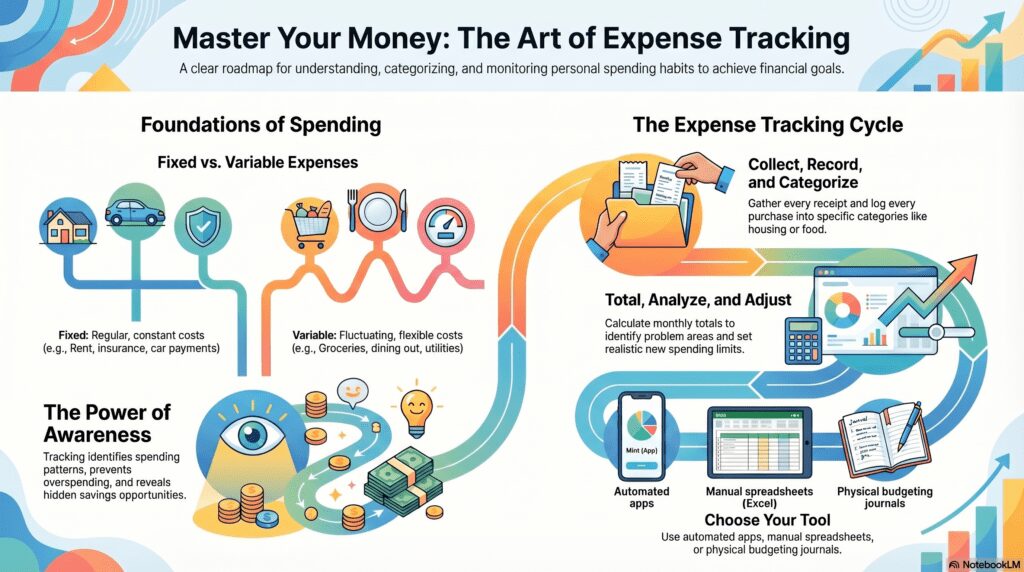
Most people who feel “broke” aren’t actually earning too little — they just don’t know where the money went. Tracking expenses is the flashlight. It shows you exactly what’s happening so you can make real decisions instead of guessing.
Patterns you never noticed become obvious once you see the numbers written out.
You can’t overspend a category you’re actively watching.
Small recurring charges you forgot about add up to real money you could redirect.
Knowing your regular spend tells you exactly how much cushion you need for emergencies.
2. Fixed vs. Variable Expenses
Every expense falls into one of two buckets. The difference matters because only one of them is easy to change.
Fixed Expenses
Same amount every month, usually non-negotiable in the short term.
Examples: rent, car payment, insurance, phone plan, student loan payment.
Variable Expenses
Change from month to month based on choices you make — and can be adjusted.
Examples: groceries, takeout, gas, entertainment, clothing, personal care.
Variable expenses are where most of your budget flexibility lives. That’s also where most of the leaks happen.
3. The Silent Killer: Subscription Creep
This one is especially real for Gen Z. Subscriptions are designed to be easy to start and easy to forget. At $10–$15 a pop they feel harmless — but they stack.
A typical stack that sneaks up on people:
| Subscription | Monthly Cost |
|---|---|
| Netflix | $17 |
| Spotify | $11 |
| Hulu | $18 |
| iCloud storage | $3 |
| Gym membership (rarely used) | $40 |
| Amazon Prime | $15 |
| Random app trial (forgot to cancel) | $10 |
| Total | $114/month |
That’s $1,368 a year — most of it on autopilot. A subscription audit (going through your bank and card statements line by line) takes 20 minutes and often frees up $30–$80 a month instantly.
4. How to Track: A Simple System
You don’t need a complicated setup. Here’s a six-step process that works whether you use an app, a spreadsheet, or a notes app on your phone.
5. What It Looks Like: A Sample Month
Here’s an example of what one month of tracked expenses might look like for someone earning $2,200 a month after taxes.
| Category | Amount Spent | Notes |
|---|---|---|
| Housing (rent + utilities) | $900 | Fixed — 41% of income |
| Food (groceries + takeout) | $380 | Variable — higher than expected |
| Transportation | $180 | Gas + one Uber ride |
| Subscriptions | $114 | Includes forgotten gym & app trial |
| Entertainment & social | $120 | Concerts, hangouts, drinks |
| Personal care | $60 | Haircut, toiletries |
| Savings | $200 | Automated transfer on payday |
| Total Spent | $1,954 | $246 left over (untracked — find it!) |
Notice: subscriptions and takeout are the two obvious trim targets. Cutting the gym and that forgotten app trial alone saves $50/month — $600 a year.
6. Which Tool to Use
The best tracking method is whichever one you’ll actually stick with. Here are the main options:
Apps (easiest)
YNAB, Monarch Money, or your bank’s built-in tools auto-categorize transactions and show visual breakdowns. Low effort, high visibility.
Spreadsheet (most control)
Google Sheets is free. Build your own categories, run your own formulas. Great if you like seeing the full picture and want to customize everything.
Notes app / journal (no-tech option)
Old school but it works. Writing things down manually actually makes you more aware because you feel each transaction instead of just seeing a number.
Check Your Understanding
Pick your answer, then tap “Reveal answer” to check yourself.
1. Which of these is a fixed expense?
A) Groceries | B) Takeout | C) Monthly rent | D) Weekend entertainment
Reveal answer & explanation
Correct: C. Rent stays the same each month regardless of your choices — that’s what makes it fixed. A, B, and D all change based on what you decide to spend, so they’re variable.
2. What is “subscription creep”?
A) Your streaming quality getting worse over time | B) Small recurring charges that stack up unnoticed | C) A budgeting app feature | D) Slowly increasing your savings rate
Reveal answer & explanation
Correct: B. Subscription creep is the way small monthly charges pile up silently — individually they seem harmless, but together they can drain $100+ a month. A, C, and D have nothing to do with it.
3. What’s the correct order for tracking your expenses?
A) Analyze → Record → Categorize → Total | B) Collect statements → Record → Categorize → Total → Analyze → Adjust | C) Budget → Spend → Save → Track | D) Categorize → Collect → Record → Analyze
Reveal answer & explanation
Correct: B. You need the raw data first (statements), then you record, then categorize, then total, then analyze, then adjust. The other orders skip steps or put analysis before you have anything to analyze.
4. In the sample monthly breakdown, which two categories are the clearest trim targets?
A) Housing and transportation | B) Savings and personal care | C) Subscriptions and food (takeout) | D) Entertainment and savings
Reveal answer & explanation
Correct: C. Subscriptions included a forgotten gym membership and a free trial that wasn’t cancelled, and the food category came in higher than expected — both are variable and cuttable. Housing is fixed and hard to change quickly. Savings should stay or grow, not be cut.
5. Why is it worth recording even tiny purchases like a $4 coffee?
A) The bank requires it | B) Small amounts don’t add up, so it’s just good practice | C) Small, frequent purchases are where patterns hide and totals surprise you | D) It’s only necessary if you use cash
Reveal answer & explanation
Correct: C. A daily $4 coffee is $120 a month and $1,440 a year — small amounts absolutely add up. More importantly, your daily habits are where spending patterns reveal themselves. Skipping them gives you an incomplete picture. B is the exact misconception that keeps people from seeing where money goes.
Key Takeaways
- Tracking expenses shows you the truth about your spending — often surprising.
- Fixed expenses are stable; variable expenses are where your flexibility (and your leaks) live.
- Subscription creep is a real, silent drain — audit yours regularly.
- A consistent six-step process turns raw bank data into actionable insights.
- The best tracking tool is whichever one you’ll actually use every month.
Now that you can see where your money goes, it’s time to decide where you want it to go. In Lesson 2.3 we’ll build your first real personal budget using everything you’ve tracked.
© Coy Academy • Financial Literacy: What School Should’ve Taught About Money