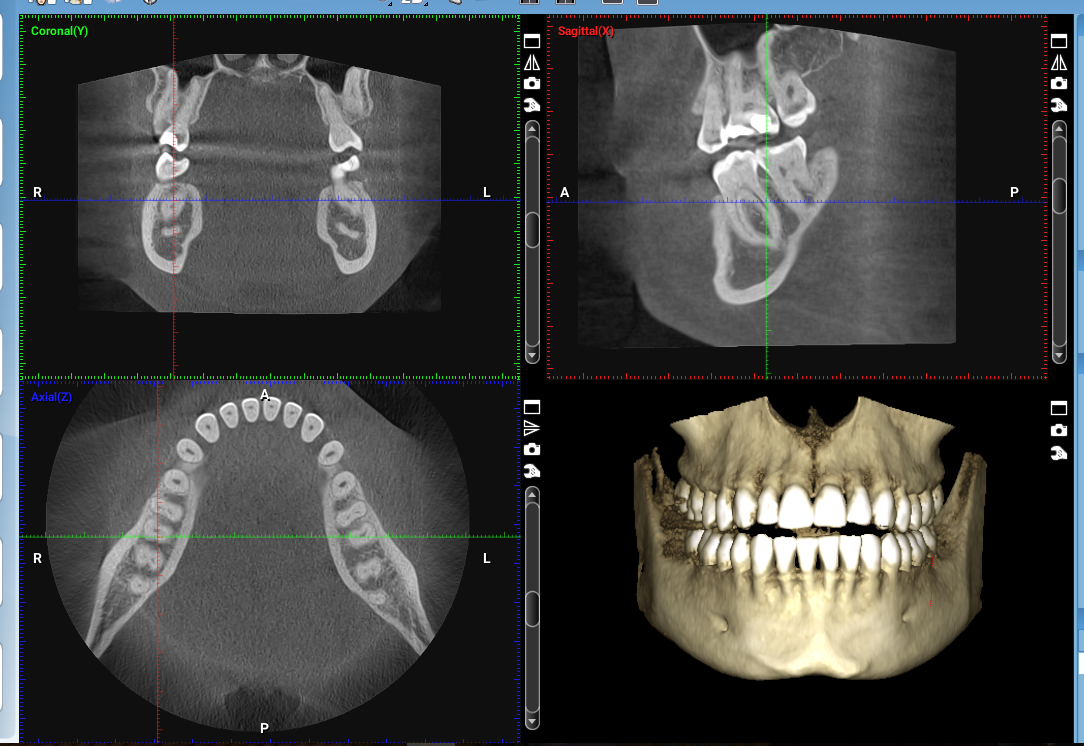
Cone Beam Computed Tomography (CBCT)
The Transition to 3D Imaging
🎯 Learning Objectives
- Define CBCT and how it differs from traditional 2D radiography.
- Identify the clinical indications for a 3D scan (Implants, Endodontics).
- Understand the concept of Voxels vs. Pixels.
- Compare radiation doses between CBCT and standard FMX.
1. What is CBCT?
Unlike a traditional X-ray that provides a flat, two-dimensional (2D) view where structures overlap, CBCT uses a cone-shaped X-ray beam to capture a series of images that a computer reconstructs into a three-dimensional (3D) model.
The Power of 3D:
CBCT allows the dentist to view the “depth” of anatomy. This is critical for seeing exactly where a nerve is located or measuring the width of bone before surgery.
2. Pixels vs. Voxels
The RHS exam loves technical definitions. You must know the difference between the building blocks of these images:
- Pixel: A 2D digital unit (found on sensors and Pano images).
- Voxel: A 3D digital unit (found in CBCT scans). Think of a Voxel as a pixel with volume.
3. Clinical Indications
Because CBCT carries a higher radiation dose than a single PA, it is only used when 2D imaging is insufficient:
| Specialty | Use Case |
|---|---|
| Implantology | Measuring bone volume and density for implant placement. |
| Endodontics | Locating extra canals or vertical root fractures. |
| Oral Surgery | Mapping the Mandibular Nerve before wisdom tooth extraction. |
🎓 DANB EXAM FOCUS: DICOM Images
The universal file format for CBCT and medical imaging is DICOM (Digital Imaging and Communications in Medicine). You may see this term in questions regarding how images are shared between specialists.